
A Primer on Carbon Capture and Storage Pipelines
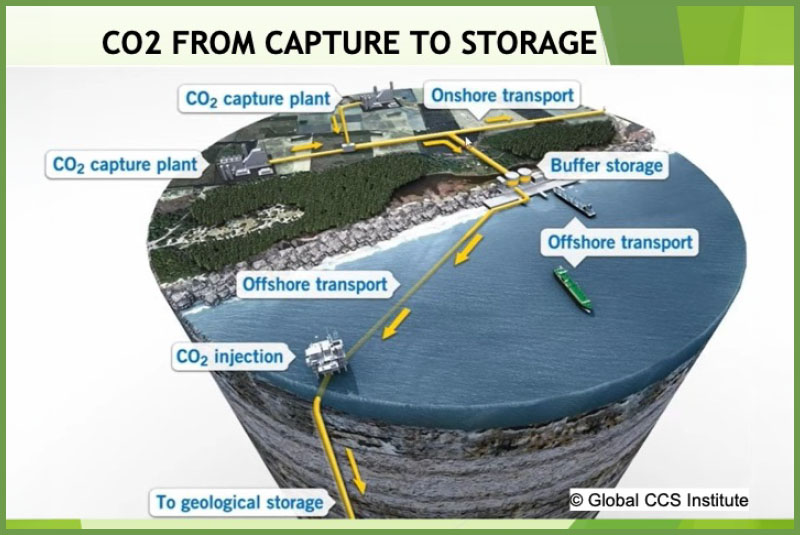
Slide courtesy of Andrew Boswell
By Ellen Robottom and Tahir Latif
The first of a two-part blog on the government’s controversial plans to invest over £21Bn in Carbon Capture and Storage (CCS)1, focusing on the dangers and hazards to local communities of the proposed UK pipeline implementations.
The GJA Steering Group meeting in February was given a presentation by Andrew Boswell, a leading technical and legal expert on matter relating to CCS, on the potential dangers of CO2 pipelines2. The image above, taken from that presentation, shows the complexity of the arrangements and the plant required to take CO2 from capture to storage. The full slide set of Andrew’s presentation needs to be seen by as many people as possible to grasp the full range of issues and can be found here.

Click to view presentation
The key point taken from the presentation is that while there will arguably be a need in the future for technology that removes and stores already-existing carbon3, that place does NOT include green-lighting the indefinitely continued use of fossil fuels, i.e. it does not provide a free pass for the fossil fuel companies to continue business as usual extractivism or negate the urgency of a rapid switch to renewables. Where it is needed, it is to solve a problem, not to allow that problem to continue and become worse.
However, CCS is a key component of the government’s climate change strategy as outlined in the report Unlocking the benefits of the clean energy economy, published in October 2025. Where in the UK the proposed CCS facilities are to be sited can be clearly seen in Slide 13 of Andrew’s presentation, including all areas of the North Sea.
One of then proposed sites is the ‘Peak Cluster’, aimed at carbon removal from cement and lime production4, in the East Irish Sea just off the coast near Liverpool, currently in its pre-planning consultation stage5. This has prompted a Letter to Ed Miliband via local MP Matthew Patrick, sent by Mike Vaughn, Managing Director of Red Rocks Nursing Home but effectively on behalf of the whole community around the Wirral.
The letter notes that ‘CCS applied to cement and lime production is widely recognised as one of the highest cost abatement pathways per tonne of CO2 avoided’ and that ‘while the probability of [pipeline] rupture may be low, the consequences are potentially severe’. This is underlined by the case studies shown in Andrew Boswell’s slide set, with Slide 3 graphically depicting what such consequences actually look like.
Mike’s letter also highlights the dangers of situating such projects in Labour’s preferred PFI/PPP nexus – government money to ‘catalyse’ private investment – which ‘ultimately socialises the long-term risk’ and ‘is difficult to reconcile with intergenerational equity.’
Unfortunately, Reform are jumping on this in certain locations (e.g. the Wirral) in the context of their ‘net stupid’ fake narrative. This makes it very important that we frame our critique firmly in an understanding that we are in a really dire situation with accelerating climate change and that this is not going to be the solution we need. More than that, the real solutions are things (good jobs in the renewables and other sectors) that help with cost of living rather than placing all the burden on already stretched households.
Part 2 of this blog will deal in more detail with then issue of jobs, with reference to a forthcoming article co-authored by GJA’s Ellen Robottom and Aled Dilwyn Fisher from Oil Change International titled ‘Jobswashing and Greenwashing: The dubious claims of Labour’s carbon capture gamble’ and to a survey of MPs that has been carried out by our friends at Platform on the role of CCS in the energy system and in employment strategy.
The introductory paragraph to the article states: ‘Beware government and corporate claims of a new industrial revolution and thousands of jobs being created by Labour’s carbon capture projects. It doesn’t take much to see that this jobswashing of a failed, extremely expensive technology favoured by the oil and gas industry is just as misleading as the greenwashing that comes with it.’ This is the essence of the false narrative around CCS, and we will return to the jobs aspects of the debate in the second blog.
Notes
- Thus far, £9bn has already been given to specific projects, but the government announced in autumn 2024 that it was committing £21.7bn to CCS. However, a search of the various subsidy schemes suggests that in fact around £50bn of subsidies is being committed to CCS-related schemes. The Climate Change Committee’s 7th carbon budget advice suggests CCS schemes would require public and private investment of £350bn – £408bn by 2050, with up to £136bn for power stations burning gas, and £128bn for burning biomass with CCS (BECCS).
- CO2 pipelines are only one aspect of the problem. The key issue for climate is the huge upstream emissions from any application based on using gas, meaning that in effect only one third of the total emissions are available for capture – even if the capture and storage technology worked efficiently, which it never has before and is unlikely to now.
- The focus needs to be on slashing the emissions now by a combination of avoiding anything that uses fossil fuels, and deep demand reduction measures (which we already largely have the technology to accomplish through electrification and structural changes reducing consumption) but that there will probably still be a need after that to remove residual excess CO2 from the atmosphere using direct capture methods, which will be more advanced by then anyway. Global storage capacity is likely to be quite limited, so we should not waste any of it on storing CO2 from unnecessary fossil fuel burning.
- Cement and lime produce CO2 as inherent process emissions, the majority of which comes from the chemical reaction involved in production rather than the fuel burning to create the high temperatures needed. It is therefore the industry most cited by the government as needing CCS; however, many argue that alternative technologies are in development – alternative building materials, and methods of recycling cement from concrete, which is where the bulk of it is used – and that demand limitation must also be a key approach. It can be argued that retrofitting with carbon capture, building a major pipeline and storage facilities, locks in an inefficient technology and effectively prevents the move to cleaner technologies that could be accomplished within a similar timescale or less.
- The Peak Cluster is in the High Peak area which spans parts of Derbyshire, Staffordshire and South Yorkshire, but the pipeline extends from there along the Wirral, where the main protests are occurring.
Further information
Document of background links provided by Andrew Boswell HERE.
MP Watch | Carbon Capture and Storage (CCS) Article, Climate Briefing by A Boswell and S Oldridge, June 2025
Join Us
Get in the loop! Sign up to receive future GJA Newsletters and Blogs here.
Join the debate
Send us your contribution to the debate. We will contact you about using it here on our News & Debate page.
