
Climate Change Awareness

Photo: Paul Atkin
Module 3: Trade Union Responses
Introduction
This Module looks at how the trade union movement is stepping up to the challenge of the climate crisis. If the climate crisis is to be tackled effectively, trade unions have a vital role to play.
Module 4 covers union-led green workplace campaigns, and how we can get involved in local and national campaigns about climate change.
There are as many trade union frontlines for tackling the climate crisis as there are trade unions!
- Many well-unionised energy-intensive industries have a huge ‘carbon footprint’ from the amounts of energy and resources they use – in power stations, steel works, food manufacture and other heavy industries. Reducing these emissions presents huge challenges.
- There are public and voluntary service frontlines, where, for example, environmental agency staff or firefighters tackle fires and floods. Or NHS staff treat increasing numbers of patients, particularly the frail elderly, for heatstroke, dehydration, and other heat-related conditions.
- There’s an education frontline, where our teachers, lecturers, trainers, researchers, managers, administrators and librarians all have a role to play in informing and raising awareness of the climate crisis.
- And there’s a transport frontline, because carbon emissions from road transport and aviation are rising rapidly, while much needed investment in public transport, including rail, bus and tram services, is totally inadequate.
Although in the UK union environment/green reps do not yet have statutory rights to training and facility time, many unions now combine the role with Health and Safety Reps, who do, and give general Reps green bargaining training.
Read the bmjopinion blog post from 2019, The summer we woke up to the health impact of climate change.
Many of these ‘frontline’ industries and services are well unionised. If the goal is to keep global temperature increases to below the ‘safe’ level of 1.5 degrees, then here in the UK, every union has some part to play. A top priority is campaigning against the austerity that denies our public services the resources they need, and the investment required for a sustainable future.
Trade unions are already backing demands for radical change.
- For a switch from petrol and diesel to electric and hybrid vehicles.
- Far greater investment in public transport and renewable energy.
- Home insulation and new ways to heat our homes.
- Sustainable agriculture, forestry and construction.
- And for new ways to manufacture products like steel, cement and chemicals that reduce the carbon emissions produced.
The trade union movement is the largest democratic movement in the world. The TUC represents more than 6.6 million workers in 47 unions. The TUC is calling for A just transition to a greener, fairer economy. It says, ‘The voices of workers who are at the forefront of dealing with the challenge of climate change must be at the centre of achieving a successful transition to the economy we will need.’
Globally, the union movement has approximately 175 million members in more than 150 countries. Combating climate change and helping workers and the communities they live in adapt to a changing world is a key trade union issue.
This module will look at how the trade union movement is stepping up to the challenge of the climate crisis
The International Trade Union Confederation (ITUC)
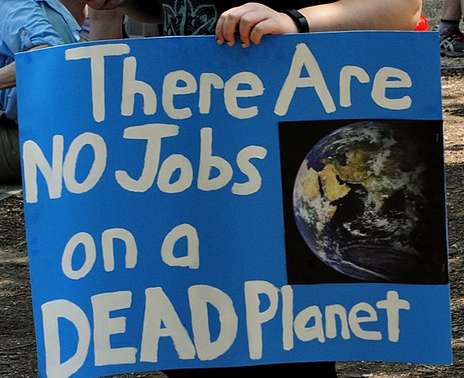 As we saw in Module 2, the International Trade Union Confederation (ITUC) leads the international trade union response to the climate crisis. It’s all part of the ITUC’s mission to promote and defend workers’ rights and interests worldwide.
The ITUC demands urgent action to tackle global overheating:
Unions want a global agreement implemented on the basis of just transition principles and plans: national and industry/enterprise plans that protect and create new jobs by investing in the necessary industrial transformation…there are no jobs on a dead planet.
Each year the ITUC submits a report to the United Nations’ climate change conference setting out its key demands. In 2025 these were:
- Make cop30 the summit where just transition becomes reality.
- Create a global system to coordinate just transition efforts.
- Recognise that workers are central to climate negotiations.
- Adopt a strong gender action plan (gap).
- Respect human rights to build trust and drive climate action.
Full statement here (2 pages).
The ITUC works for international solidarity between trade unions to support these goals. Its regional organisations coordinate unions in each continent: the Asia-Pacific Regional Organisation (ITUC-AP); African Regional Organisation ITUC-AF); American Regional Organisation (TUCA); and European Trade Union Confederation (ETUC).
ITUC’s Just Transition Centre
The ITUC set up a Just Transition Centre in 2016. It brings together workers and their unions, communities, businesses and governments in social dialogue to ensure that labour has a seat at the table when planning for a Just Transition to a low-carbon world. The centre is building up a network of ‘good practice’ in Canada, Germany, the USA, Australia, the UK and elsewhere.
Worldwide, people are losing their lives and livelihood through climate change. The ITUC sees this as a major issue as it campaigns for workers’ rights, health and safety, and an end to poverty. As countries shift to renewable energies and a low carbon economy then workers and communities dependent on the fossil fuel industries for their income will suffer unless the transition is managed carefully. So a key aim of the ITUC is to develop a strategy for ‘a just transition’ for workers and communities, ‘to ensure we are all part of a sustainable, low carbon economy and benefit from decent and green jobs.’ (1)
Below is a section from that ITUC document outlining what is meant by a just transition.
A Just Transition means:
- Giving unions a voice, from the workplace to the highest levels of government. Negotiations with government and employers. Collective bargaining with workers and their unions for workplace change, boosting productivity and skills.
- Investment in jobs and skills – providing decent work opportunities in sectors which cut emissions.
- Invest in community renewal to win the trust of regions and communities at the forefront of industrial change.
- Respect the contribution that workers in fossil-fuel industries have made to today’s prosperity. Provide them with income support, retraining and redeployment opportunities, and secure pensions for older workers
- Guarantee social protection and human rights
- Support innovation and technology sharing to enable a rapid transformation of energy and manufacturing.
- Decent work and union rights in the transition to a low carbon economy.
Call for Dialogue: Climate Action Requires Just Transition (2)
Watch the following video where Peter Colley (National Research Director for the Construction, Forestry, Mining and Energy Union in Australia) talks about what a just transition means for one set of workers, those working in the coal industry.
Ending Climate Change Demands a JustTransition for Coal Workers

The European Trades Union Congress
The ETUC leads the European trade union delegation to the UN climate conferences and lobbies the European Commission and Parliament for tough action to cut greenhouse gas emissions and create sustainable jobs for the future.
 The ETUC argues that energy and industrial policy must work hand in hand to tackle climate breakdown.
It calls for a Just Transition and supports trade unions campaigns across the EU. One of the projects it helped get underway was the Low Carbon Task Force in Yorkshire and Humber, led by the regional TUC and its union and other partners. The Yorkshire region has the highest carbon footprint of any UK region, with its combination of heavy industries and power stations.
Although the Task Force itself was relatively short lived, it supported and fed into the formation of the Yorkshire and Humber Climate Commission, which the TUC still has a Commissioner place on, and has underpinned ongoing union-government and union-industry engagement since. It also supported the emergence of the Green Skills Taskforce in the West Yorkshire Combined Authority.
It thereby helped create a positive atmosphere around Yorkshire doing well with climate action that creates its own momentum.
Setting up place-based just transition commissions of this sort is TUC policy, so this positive example of trade union initiative acting as leadership and catalyst should be replicated everywhere. What Yorkshire does today…
Involving Trade Unions in climate action to build a Just Transition: guide & video
The Trades Union Congress (TUC)
The TUC brings together unions in the UK to agree common policies on issues that matter to working people and their communities. It represents more than 5.5 million workers in 47 unions.
TUC policy on energy and the climate crisis is developed through debates at the organisation’s annual Congress. The TUC published A just transition to a greener, fairer economy (July 2019) demanding:
- A Commission on long-term energy strategy for a low carbon future. Unions, industry and consumers should be at the table.
- Workplace Transition Agreements in companies and organisations: covering jobs, skills, pay and other issues. Unions should have access to all workplaces to explain the benefits of trade unions.
- Every worker should have access to funding to improve their skills. ‘Workers in energy-intensive sectors have the skills and expertise that will be required to help these sectors transition to lower carbon models.’ Support for apprenticeships, the best guarantor of skills excellence. Proper funding of the adult education sector.
- Government-led investment in household energy efficiency, public transport, and public service responses to extreme weather.
- The ‘green economy’ (and beyond) must recognise unions and bargain with them to ensure good quality jobs ‘with terms and conditions at least as good as those in energy and carbon-intensive sectors.’
The TUC’s work on energy and climate change also includes greening the workplace. In 2014, a TUC report on The Union Effect- Greening the Workplace, showed how union reps led green workplace initiatives. The TUC also wants statutory rights for trade union environment reps, both in terms of training and facility time. Their role would be to:
- promote environmentally sustainable workplace initiatives and practices
- carry out environmental risk assessments and audits
- consult on workplace environmental policies, practices and management systems
- receive relevant training (5)
In 2025 the TUC produced the Greener Workplaces for a Just Transition Toolkit to help union officers and reps in England who want to take action on the climate emergency, future-proof their jobs, and negotiate for greener and fairer workplaces. It is designed to support the voice of workers and their unions and is designed to be used on TUC and union training courses, as well as to support action in the workplace and at community level.
In 2024 the TUC set up its Worker Led Transition Team to:
- future-proof manufacturing jobs by accelerating climate action
- support trade union reps in high carbon manufacturing industries
- develop and promote worker-led decarbonisation plans.
- build capacity and organising strategies amongst union members
- grow supportive campaigns for worker-led transition plans, to protect jobs against offshoring while cutting carbon emissions.
By
- providing information, tools and ideas to campaign, organise and raise awareness.
- Developing negotiating and bargaining checklists on different areas of workplace sustainability to ensure that workers, through their unions, have a central voice in the changes that will be needed in every workplace to ensure a just transition to a greener and fairer UK.
They cover the following sectors
- Automotive
- Steel
- Ceramics
- Glass
- Chemicals
- Wood products
- Cement
- Offshore supply chains (e.g. assembly, metal fabrication)
It can be contacted at futureproofing@tuc.org.uk
Energy
The TUC supports a transition to a net zero carbon energy mix, in line with scientific targets, including renewable power, nuclear, and hydrogen. The TUC advocates for public energy companies to champion building new clean energy capacity like floating offshore wind farms, and make sure these are built on time and create good jobs. Public energy companies should also have a role to play in bringing down energy bills and making sure our homes don’t waste energy.
However, union opinions vary on some of these priorities, notably the role of hydrogen for heating homes and nuclear power.
- Some unions support a switch to hydrogen for heating our homes and that natural gas is a transition fuel. Others argue that natural gas (methane) is a fossil fuel that is part of the problem and that hydrogen cannot be produced at scale economically or sustainably and that electrification is a better option.
- Proponents of nuclear power argue that a new generation of nuclear power stations is essential to ensuring security of supply and keeping the lights on. Those opposed are concerned about the displacement of cheaper renewable energy from having to keep them running once they are built, their high cost, the long delays in their construction, safety and the dangerous waste which has the potential to be harmful for tens of thousands of years (in the case of Uranium 235, 704 million years – which is almost three times longer into the future than the dawn of the dinosaurs was in the past).
The TUC opposes ‘fracking’ on the “precautionary” basis of the occupational, environmental and regulatory issues involved.
International
 The TUC and its affiliates have strongly supported the efforts of the ITUC to lobby for a strong and effective global agreement on climate change. The Paris Agreement set a new goal to reach zero emissions by the middle of the century.
The TUC argues that:
Climate change affects our brothers and sisters – especially our sisters – across the world. UN figures show that 80 percent of those displaced by climate change are women. The Paris Agreement identifies global solutions to a global problem; it has made specific provision for the empowerment of women, recognising that they are disproportionately impacted by climate change, and a just transition must provide fairness and overcome injustices experienced by all workers, male and female, young and old, black and white, in the global north and south.
The UK is legally bound by the 2008 Climate Change Act to reduce emissions by 100% by 2050. Challenges in court that the previous Conservative government’s action plans were not adequate to meet their targets have forced the current Labour government to produce a more robust version which Friends of the Earth describe as follows.
This new climate plan – officially calledthe Carbon Budget and Growth Delivery Plan – is stronger on carbon reduction delivery and stronger on making life much better for people with lower bills, cleaner air, warmer homes, etc.
But the new climate plan is far from risk free, particularly with overly optimistic expectations for new technology. And even though it is fairer than previous plans, it still falls short of what it could do to address deep inequalities in the UK. And for the UK to do its fair share globally it should be aiming at deeper emissions cuts.
Overall, is it fit for purpose? We don’t think it is fully, but it’s a step forwards. It will take a lot more campaigning over coming years if the UK is genuinely going to be a world leader on climate change. Full statement here.
Trades Unions
As well as the common policies agreed by the annual Congress of the TUC, many unions have developed their own policies and campaigns around climate change and the environment. Below are some examples.
UNISON

UNISON, the public services union with 1.3 million members, has called for strong action on climate change for many years and originated the call for the Trade Union Year of Climate Action for 2026
Their programme of activity for the year is here.
Green UNISON Week – UNISON’s branches across the UK have organise a week of local and national activities in September (to coincide with national green week) to call for urgent action to tackle climate change.
Green Reps in UNISON – in 2022 UNISON members voted overwhelmingly, at their annual National Delegate Conference to include Environmental Officer as one of the mandatory officer roles for every UNISON branch. Their guide for the role is here.
UNISON’s Climate change and your pension: divestment guide to campaigning through your branch for your local government pension fund to pull all investments in fossil fuels, commonly known as divestment.
Their comprehensive green bargaining guide Bargaining on green Issues in the workplace can be found here.
Public and Commercial Services Union (PCS)
PCS has a long and proud record of bargaining and campaigning on green issues both within and outside the workplace. Tackling climate change and environmental degradation is integral to our industrial agenda, and our green reps and members are vital to ensuring we put our policies into practice as part of a Just Transition. John Moloney, PCS Assistant General Secretary
The Public and Commercial Services Union is one of the largest trade unions in the UK, representing members across the UK, Scottish and Welsh civil services, the public sector, and parts of the private sector. As part of our commitment to protecting members and the planet, PCS is putting a Green Bargaining Claim to the UK civil service setting out how the civil service can lead the way on climate action and fairness at work.
PCS’s environmental, climate and bargaining work now focuses on the following areas:
1. Workplaces
PCS is growing and supporting a network of workplace environmental or ‘green’ reps. They receive training, guidance and regular updates, and are encouraged to work together across departments, regions and nations.
Our Green Bargaining Claim calls for formal recognition and facility time for these reps so they can carry out essential tasks such as workplace environmental audits, monitoring progress, engaging with local management, and developing good practice.
We are also demanding proper green bargaining arrangements in every department, where unions and employers can agree practical steps towards decarbonising the civil service estate — including carbon budgeting, better data, sustainable procurement, climate‑proof buildings and greener ways of working. PCS continues to support proposals such as a publicly led National Climate Service.
2. Campaigns and activism
PCS works alongside organisations including the Greener Jobs Alliance, the Campaign against Climate Change Trade Union Group, Fuel Poverty Action and Trade Unions for Energy Democracy. We remain active on fossil‑fuel divestment, just transition and defending workers’ rights.
Our Green Bargaining Claim also reflects the wider issues that shape climate justice — including migrant and refugee rights, tackling fuel poverty, funding worker retraining into green jobs, and supporting members to reduce their own carbon footprints through fair financial measures.
PCS is a proud member of the Climate Justice Coalition and continues to play a leading role in its trade union caucus.
3. Policy
PCS policy is set democratically each year at our Annual Delegate Conference. Key areas include the transition to 100% publicly owned renewable energy, opposition to nuclear weapons and fracking, and rejecting false climate solutions.
The Green Bargaining Claim also calls for changes to the Civil Service Code and Ministerial Code so civil servants can challenge non‑evidence‑based work and uphold legal environmental obligations.
We are pushing for compulsory sustainability training for all civil servants, expanded training for senior staff, properly resourced climate‑related teams, and greener travel options — including improved public‑transport support, updated cycling schemes, electric vehicle incentives, and local travel plans to reduce car use.
Contact green@pcs.org.uk for more information on its campaigns and policy work.

National Education Union (NEU)
The NEU organises nearly half a million teachers and teaching assistants.
The main NEU initiative for the first part of the Year of Action is the Climate and Nature Education Conference on March 14th, which is being organised with other education unions and the Ministry of Eco Education. Full details here.
Climate Change has been discussed at its conference every year since 2015.
It has an active Climate Activists Network (email neuclimatechangenetwork@gmail.com to sign up) now regularly runs Green Reps Courses and has provided one of the two UK trade union reps at COPs for the last four years. Her blog on activities and decisions made at COP30 can be accessed at faircop
The union seeks to unite all the education unions to mobilise on
- what is taught, making a curriculum fit for the future, alongside campaigns like Teach the Future
- schools to sign up with Lets Go Zero 2030 and the Ministry of Eco Education
- implementing the DFE’s Net Zero strategy initiatives, like the National Education Nature Park, sustainability leads for every school; and pushing for it to go further to retrofit the whole school estate by 2030
- adaptation to climate impacts on schools, like extreme weather.
Supportive material on the climate change page of their website includes learning resources, a green reps checklist and the joint unions heatwave protocol.
University and College Union (UCU)
The UCU represents over 120,000 academics, managers, lecturers, administrators, trainers, librarians, instructors, computer staff, researchers, designers and postgraduates. They are employed in universities, colleges, prisons, adult education and training organisations across the UK.
UCU has established a network of over 150 UCU Environment Representatives, supplemented with training courses on the Role of the Environment Rep. UCU also provides free training for all memberson themes related to climate, sustainability and education. Their key work on the includes:
- encouraging branches to have at least one ‘environment or green rep’ to negotiate locally for UCU’s Green New Deal for colleges & universities, supported to share information via a UK-wide network
- encouraging branches to work with campus stakeholders, including student representatives and local communities, to convene ‘action groups’
- local and national cooperation with other trade unions and the TUC to press for greener government policies
Action areas and campaigns:
UCU’s campaigns and resources are collected in their ‘Climate and Ecological Emergency’ pages, with highlights including:
- UCU Green New Deal (GND). The Green New Deal (GND) brings together policy set by both UCU and NUS within a negotiating and bargaining framework. Demands include that institutions declare a climate emergency, agree concrete time limited action plans on embedding meaningful environmental policies, climate-proof their curriculums, sign up to ethical investment and banking strategies, review food and land use, travel policies and carbon and energy management commitments. It was launched in 2021. In 2022, Liverpool UCU branch launched their branch-specific GND claim, engaging with their employer.
- Just Transition Framework for Colleges. Agreed between the Joint Trade Unions and the Association of Colleges (AoC, the employer body in England), as the outcome of national negotiations, this represents a collaborative approach to support the FE sector to meet the challenges and opportunities presented through a transition to net zero. More information on the framework.
- Commissioned research identifying the deficit in skills funding needed to support the net-zero transition. The report highlights that the UK’s education system is not producing the skills required to achieve a just transition, and that fixing this will mean reversing decades of underfunding, alongside recommendations for modernisation.
- A programme of member-led events and structures supporting those working in tertiary education to learn and collaborate on environmental issues, and to steer the political direction of their union.
UCU is proud to have supported the founding and continued work of the Greener Jobs Alliance – now a pillar of the UK and international labour movement’s work on environmental justice.
Bakers Union 
The Bakers, Food and Allied Workers Union (BFAWU) successfully moved a motion around climate change at the TUC Congress in 2017, calling for a just transition to a renewable energy industry, energy democracy and recognition of environmental reps.
BFAWU has been working away in the background to develop its environmental strategy:
- Adapting the current Health and Safety Reps role to include an environmental aspect – transitioning into safety, health and environment reps (SHE).
- Publishing a Green version of their journal the Foodworker to coincide with COP each year and focusing entirely on environmental issues.
- There are dedicated social media accounts @BFAWUGreenstuff on Facebook and Twitter page @BFAWUS.
For content to go into the newsletter, or to find out more, contact: Green@bfawu.org
BFAWU now recognises Green Reps in their rule book and has a Green Reps Network.
Trade Unions for Energy Democracy
Trade Unions for Energy Democracy (TUED) is an international network which calls for publicly and democratically owned energy. This would mean restructuring the global energy system to scale up renewable energy, energy efficiency and job creation.(7)
Watch the following animation that explains what is meant by energy democracy.
This Is What Energy Democracy Looks Like
These are just some examples of individual union policies and good practice in tackling climate change and greening the workplace. You can find details of your union’s policies on their website or by contacting their research department. Trade unions have a long history of taking action on environmental issues as they’ve campaigned for safer, healthier, working and living environments. Consequently, they have a unique and valuable role to play in raising awareness and mobilising people to address the challenge of climate change.
In the following video published by the ITUC straight after the Paris Agreement, trade unionists and climate campaigners talk about the importance of the labour movement working together with other social movements to tackle climate change and fight for a just transition to a zero-carbon economy.
After Paris: Organising for a #JustTransition
Further reference
Trade Unions for Energy Democracy